


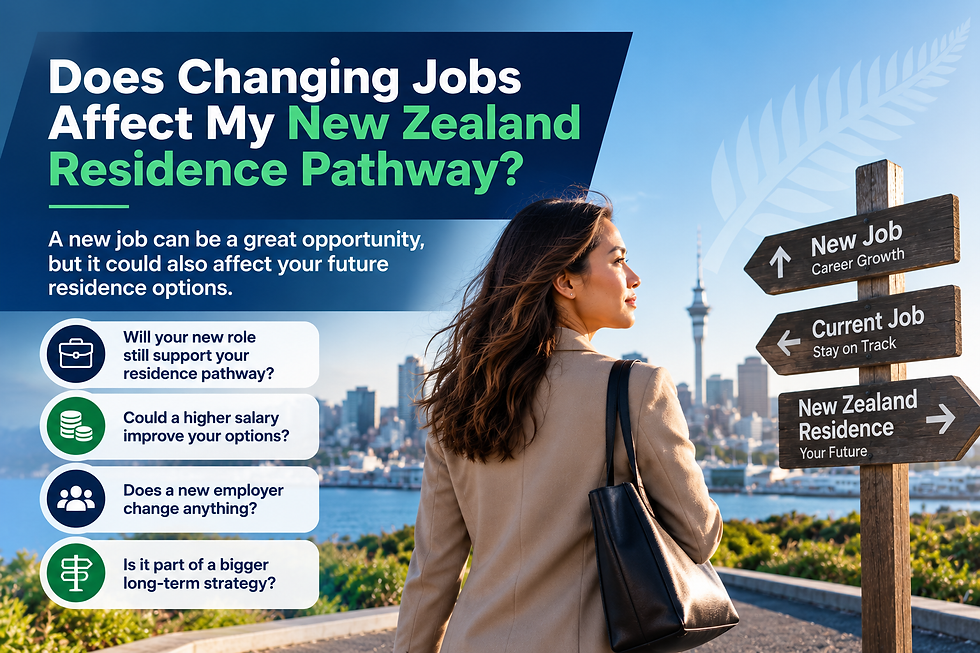
Does Changing Jobs Affect My New Zealand Residence Pathway?

Changing jobs in New Zealand can be an exciting step. You might receive a better salary, more responsibility, improved working conditions or an opportunity to progress your career.
But if your long-term goal is New Zealand residence, there is another question you should ask before accepting the new position: Could changing jobs affect my pathway to residence?
The answer can be yes. Your occupation, job duties, pay, skill level, employer and the type of work experience you are accumulating can all be relevant to a future residence application.
We see migrants focus on whether they can legally move into a new job without first considering what that change could mean for their long-term immigration strategy.
Sometimes a new position improves your residence prospects. Sometimes it can delay them. In other situations, it may move you onto a completely different pathway.
That is why we recommend looking beyond your next work visa and considering where the new job could take you in the future.
Can Changing Jobs Affect Your New Zealand Residence?
Yes, potentially. New Zealand has several skilled residence pathways, and they do not all assess employment in the same way.
Depending on your circumstances, your residence pathway could be influenced by factors such as:
Your occupation
The work you actually perform
Your skill level
Your remuneration
Your qualifications or registration
How long you have worked in qualifying employment
Whether your employment meets the requirements of your intended residence pathway
Changing one of these factors can potentially change your residence position. The important point is that being able to take a job does not necessarily mean it is the best job for your residence plans.
A Better Job Isn't Always a Better Immigration Move
Imagine being offered a new position with better hours, a slightly higher salary and a job title that sounds more senior. From a career perspective, it may look like an obvious move.
From an immigration perspective, there may be more to consider.
The new position could be assessed under a different occupation. Your duties may have changed. The work may fit differently within the residence pathway you have been working towards.
Alternatively, the new position might actually put you in a stronger position for residence.
The key is finding out before you make the move.
Your Occupation Can Matter More Than Your Job Title
One area that can cause problems is assuming that your job title determines your occupation for immigration purposes. It isn't always that simple.
Two employers might use completely different titles for people doing essentially the same job. Likewise, two employees with the same job title might actually perform very different duties. When assessing skilled employment, the substance of your role can matter.
This becomes particularly important if changing jobs also means changing:
Responsibilities
Technical duties
Seniority
Supervisory responsibilities
Type of work performed
A seemingly small change can sometimes have a much larger immigration consequence.
What Happens to the Work Experience You've Already Built?
This is one of the most important questions to ask before changing jobs. Many New Zealand residence pathways involve accumulating particular types of work experience.
If you've already spent months or years working towards residence, you don't want to discover later that changing roles affected how some of that experience is treated.
Whether previous and future employment can work together towards a particular residence pathway depends on your individual circumstances.
This is particularly relevant under the current Skilled Migrant Category, where your occupation, skilled work experience, remuneration and other factors may all need to align with the pathway you intend to use.
Don't simply assume: "I've worked in New Zealand for three years, so all three years will count." It may require a much closer assessment.
Moving Into a More Skilled Role Could Improve Your Options
Changing jobs isn't necessarily a problem. In some circumstances, career progression could significantly improve your future immigration options. For example, moving into a genuinely more skilled occupation may potentially open residence opportunities that were not available in your previous position.
This is particularly relevant for migrants currently working in Skill Level 4 or 5 occupations who have opportunities to progress into Skill Level 1, 2 or 3 work.
Career progression might happen through:
Promotion
Further training
Additional qualifications
Increased technical responsibilities
Moving into another occupation
But timing matters.
Some residence pathways require you to build qualifying experience. Moving into the right role shortly before your visa expires may leave you without enough time to take advantage of the opportunity.
Could a Pay Rise Change Your Residence Options?
Potentially. Remuneration continues to play an important role across parts of New Zealand's skilled residence system. A new position with higher pay could therefore improve your circumstances. But looking only at the headline salary can also be misleading.
Your occupation, employment conditions and the particular residence pathway still need to be considered together.
We have seen migrants focus heavily on earning more without first establishing whether the new employment actually supports their intended residence pathway. Residence planning needs to look at the complete picture.
What About Changing Employers but Keeping the Same Job?
This is another question. You might be performing essentially the same work but receive an offer from another New Zealand employer. That does not automatically mean your residence plans are affected, but it also shouldn't be assumed that nothing changes.
Your new employment arrangement should be reviewed alongside your immigration status and long-term plans. There may also be separate work visa considerations that need to be addressed before you start working for the new employer.
Getting advice before resigning from your existing position can therefore be extremely important.
Don't Make a Career Decision Based on Immigration Advice from a Friend
We hear variations of this regularly:
"My friend changed employers and it was fine."
"Someone at work told me this occupation qualifies for residence."
"My colleague has the same job and their adviser said they qualify."
Their circumstances are not necessarily your circumstances. They may have a different qualification, pay rate, employment history, occupation, visa history or residence pathway.
Even two people working beside each other can have different immigration outcomes.
Use other people's experiences as a reason to ask questions—not as confirmation that the same answer applies to you.
Your Next Job Could Be Part of a Bigger Residence Strategy
If you want to remain in New Zealand permanently, employment decisions should ideally form part of a broader immigration plan.
Instead of only asking: "Can I take this job?" Consider asking: "Where does this job leave me in one, two or three years?"
That is a very different question.
A residence strategy may involve considering your current employment alongside your experience, qualifications, remuneration, career progression and the residence pathways potentially available to you.
Sometimes the best decision is to take the new job. Sometimes staying in your current position longer could be important. Sometimes a different career move may provide better long-term opportunities.
The answer depends on your circumstances.
Talk to Us Before You Change Jobs
The best time to review the immigration implications of a new job is before you accept it, resign or start working.
Once you've already made the change, your options may be more limited. We can review your current position, the proposed new employment and your longer-term New Zealand residence goals.
Importantly, we aren't just looking at whether you can obtain your next visa. We can look at where that decision could leave you further down the track and whether it aligns with the residence pathway you're working towards.
If there is an issue, identifying it before you change jobs gives you an opportunity to make an informed decision.
Planning to Change Jobs in New Zealand?
If you're considering a new job and New Zealand residence is your long-term goal, don't make the decision based on salary and job title alone.
Your next career move could strengthen your residence pathway—or potentially change it altogether.
Talk to us before you make the move.
We can assess how the proposed employment fits with your immigration status and long-term residence strategy, so you understand the potential implications before making your decision.


Comments